The AeroTimes Aviation Research Center is a space with thousands of aeronautics-related reading materials from all over the world. You can find magazines, brochures, books, manuals and pictures.
Some of these books and magazines have been stored in libraries around the United States and Europe for years and thanks to digitization efforts from organizations like Google they are now seeing the light again.
This resources have been collected trough various years of searching a huge number of online repositories like archive.org, Smithsonian, universities, public libraries, etc.
Samuel P. Langley

Samuel Pierpont Langley was born in 1834 in Roxbury, Massachusetts. He was the son of Samuel Langley and Mary Williams; Langley’s father was a merchant in Boston. The Langleys came from old English stock, including the Mather and Adams families. Langley began his education at the Boston Latin School and was reading books on astronomy by the age of nine. His brother John helped him build astronomical instruments and together they experimented with refractor types. They observed the phases of Venus, craters and “seas” on the moon, the Galilean moons of Jupiter, and the rings of Saturn.
He graduated from Boston High School but there was no work in astronomy. Langley was adept at making and using tools and working with his hands but he was undecided as to what career path to follow. This led him west to St. Louis and Chicago to pursue a career in architecture. He apprenticed to architects and designers in the mid-west and developed skills in mechanical and free-hand drawing. However architecture proved to be unrewarding to Langley so he returned to Massachusetts and got back into making telescopes using the new silver-on-glass refractors.
In 1887, Langley became the third secretary of the Smithsonian Institution. During his tenure at the Smithsonian, Langley continued his research into flying and eventually developed his “aerodrome” or flying machine. While he had worked on winds, body design, engines, and so forth, Langley was still well short of a machine that could be stabilized, steered, and otherwise be controlled in the air. This was the essence of what he needed to create: a flying machine that was sustained, self-propelled, controlled, and carried a human.
Langley’s aerodrome evolved over time as Langley’s experiments taught him new lessons. Each aerodrome was an improvement upon the previous one but still, short of his goal. In 1893, he used a houseboat to launch his latest steam-powered aerodrome considered ready for flight. But, this flight failed because it was unmanageable in a breeze. Continued attempts brought no success. His fourth and fifth aerodromes taught him valuable lessons but also raised more questions. Aerodrome no. 5 rose, then slid back to the water after a flight of a few seconds and thirty-five feet.


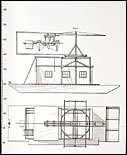
The Flying Machine Samuel P. Langley
Alberto Santos-Dumont

 |
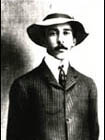 |
Alberto Santos-Dumont was a Brazilian aviation pioneer, deemed the Father of Aviation by his countrymen. |
|
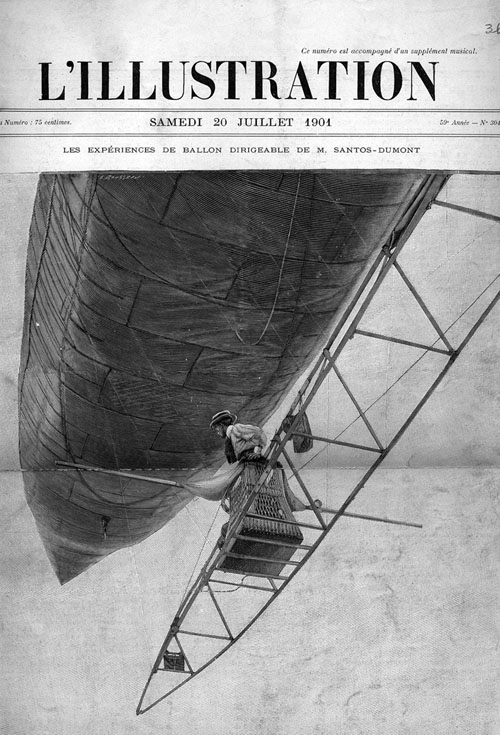
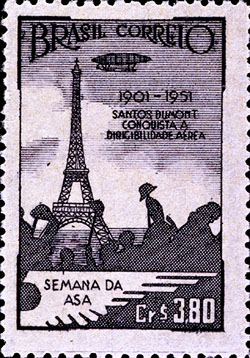
Alberto Santos Dumont was born July 20, 1873, in the village of Cabangu, State of Minas Gerais, Brazil. At the age of 18, Santos Dumont was sent by his father to Paris where he devoted his time to the study of chemistry, physics, astronomy and mechanics. His first spherical balloon, “Brasil,” ordered from Maison LaChambre, with the capacity of 113 cubic meters, capable of lifting a ballast of 114.4 lbs, and having in its lower part a wicker basket, made its first ascension in Paris on July 4th, 1898. His second balloon, “America,” had 500 cubic meters of capacity and gave Santos Dumont the Aero Club of Paris’ award to study the atmospheric currents. Twelve balloons had participated in this competition but “America” reached a greater altitude and remained in the air for 22 hours. Putting aside the aerostation, he began to devote himself towards solving the problem of steering the balloons. His first steered balloon, “Santos Dumont no. 1,” ascended on September 18th 1898. Balloons “Santos Dumont no. 2,” which wasn’t successful, and “Santos Dumont no. 3,” built at the Vaugurand workshop, followed. “Santos Dumont no. 3” ascended on November 13th, 1890. It circled a few times the Eiffel Tower, headed to the Park and from there finally headed towards the Bagatelle field where it landed flawlessly. In view of the success of no. 3 balloon, the Aero Club of France was founded and Mr. Deutsch de La Meurt instituted the “Deutsch Prize” to be awarded to the balloonist who, taking off from Saint-Cloud, circumnavigated the Eiffel Tower and returned to the starting point in less than thirty minutes. This prize was conquered by Santos Dumont on October 19th, 1901, with dirigible no. 6. Besides this prize, Santos Dumont received the sum of 100,000 francs which he distributed in equal parts to his workers and the beggars of Paris. Dirigibles nos. 7, 8, and 9 followed. With the latter, on July 4th, 1903, Santos Dumont maneuvered over Longchamps, where a military parade was being held in commemoration of Bastille capture. Once he solved the problem of steering the lighter-than-air vehicle, Santos Dumont devoted himself to the heavier-than-air problem. Aboard the 14-BIS he made his first unsuccessfull attempt in July, 1906. On September 7th, the 14-BIS wheels left the ground for a moment; on the 13th it could reach the height of one meter; on October 23rd, the airplane flew 50 meters.
|
||

International Aviation Library
Aircraft Journal Magazine 1919
Aviation by Claude Graham-White
Libro Aeronáutica Civil Mexicana SCOP
Revista Caminos del Aire Mexicana de Aviación
Historia de la Frabrica de Aviones en Tijuana Mexico
Tesis El Nacimiento de la Aviacion en Mexico
Flight Crew Human Factors Handbook (CRM) CAA UK
Revista Tohtli Digitalizada Tomo 1
Revista Tohtli Digitalizada Tomo 2
Pioneer Aircraft Early Aviation to 1914
 Recursos de Aviación